Showing posts with label training notes. Show all posts

Sunday, November 27, 2011

Carbine Training: Driving the Rifle

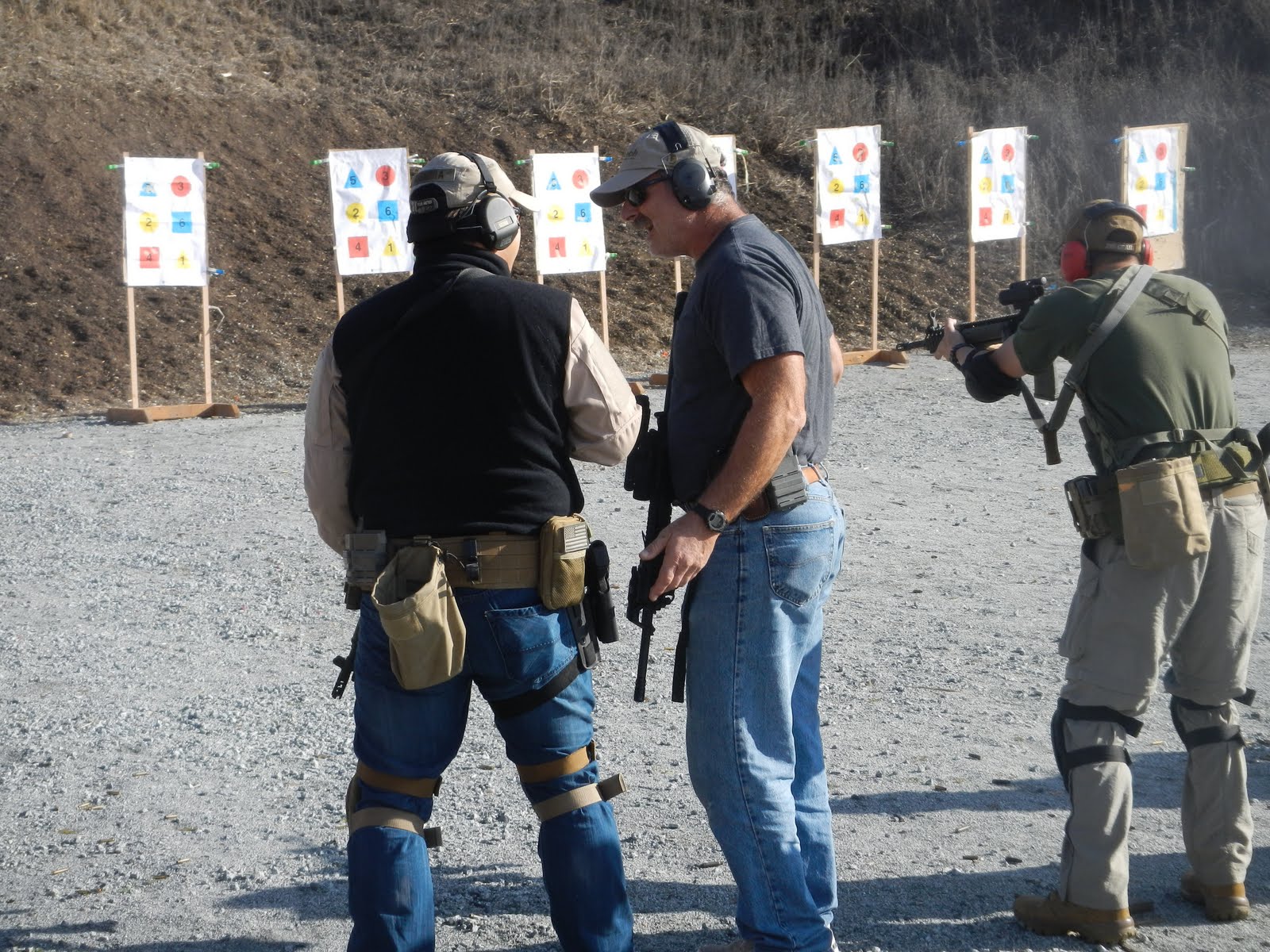
Finished up a one day carbine training class focusing on "Driving the Rifle" which basically means moving your rifle from target to target with your eyes leading the way and already on the next target.

We trained firing multiple rounds at a target, then multiple rounds per target at multiple targets, all geared toward getting out of the habitual "double tap".

Once the basic skills and concepts were learned they were all put together in the form of several skill developing drills.

We did a bunch of drills one being the "1 - 5 Drill". This drill is a lot of fun. Basically, you have three IPSC targets set up in a row 5 yards away. You have to shoot 1 - 2 - 3 - 4 - 5 rounds in each target. Starting at the far left target to to the far right target then back to the far left target for a total of 15 rounds.

I managed to get in a time of 3.37 seconds on my fastest try. It's a fun one!


Also, transitioning to your secondary weapon when the primary fails was taught along with a bunch of other great stuff!

Check out the short video:

Sunday, May 10, 2009

Nice day at the range today


Had some fun at the range today. Just confirming my zero's for my rifles.

I got to practice my marksmanship skills:

  1. Sight Alignment - Properly aligning your front sight with your rear sight.
  2. Trigger Control - maintaining correct sight alignment while squeezing the trigger.
  3. Breathing - The point at which when you are exhaling all movement has stopped - then pause - all this in conjunction with the trigger squeeze.
    Breath control for engaging single targets.
    Breath control while engagement of short-exposure targets.
  4. Follow Through - watching your sights or being aware of their position throughout the total sequence, slowly releasing the trigger once the shot breaks until the trigger resets.


Advanced Marksmanship

Sniper Marksmanship
Advanced Rifle Marksmanship

Thursday, April 16, 2009

Up for auction: 1958 S&W Modlel 41: Nice.

It's auction time again at Rock Island

Here are some of my picks...


Now is your chance to get a 1958 S&W Model 41 serial #4219. The Model 41 serial # started at 1,401 in 1957 which they made 679 units. Then in 1958 they made 9,875 units making this one an early 1958 model.

I'd like to get my hands on that one. Drool!

They also have an even older one without the fancy target grips:


A nice Colt Ace:


This is a Colt Ace that was manufactured in 1933. The pistol has the Colt commercial blue finish, checkered walnut grips and a magazine stamped: "COLT/ACE/.22 L R" on the floor plate. The barrel is blued with a polished chamber. The pistol has an adjustable target rear sight and half moon front sight. Standard markings on the slide, with "99" on the right side of the trigger guard, checkered trigger, wide hammer, and arched mainspring housing.

Now for some of the odder firearms for sale.

They have a WTF gun for sale.

Handmade, single shot pistol allegedly used by the French, but writer believes it to be Vietcong. It is a crudely constructed handmade piece with a three piece frame hammered and welded together. The trigger guard can be unfastened from the front strap and swings forward for an unknown reason. The barrel is part round and the bore is tapered much like that for a rifle round. The barrel release is mounted on both sides of the frame and the barrel tips upward at the breech. The hammer and trigger are large and crudely made and the pistol is fitted with checkered two piece grips. The right side of the frame is marked "5411" and there is a crude zigzag pattern on most of the pistol. The pistol fires in single action only.


I like the pictures.

Here's an nice General Motors FP-45 Liberator Model 3 Single Shot Pistol


Produced by the Guide Lamp Division of General Motors from 1942-1945, the Liberator was issued the nomenclature "Flare Pistol, 45 Caliber" in order to obscure it's true purpose; to be airdropped in occupied territories and be used to eliminate a German soldier and steal his weapon. Given the smooth bore and crude sights, this was a task best performed from immediately behind while the soldier was alone. This is a Model Three, three hole model that was made from sheet metal stampings that were spot welded together on top of the smooth bore barrel, and fitted with a cast zinc cocking knob with integral guide pin. The grip is hollow to store additional rounds, and fitted with a replacement homemade cover.

Here's a gun I like to cal "Mr. Nasty":


One of the more interesting arms of the Western era, the Apache serves as a pinfire revolver, brass knuckles, and a trench knife style fighting blade. Manufactured without sights, the frame and knuckle section are constructed from solid German silver, with a steel cylinder and small parts. The front right side of the frame is marked "L. DOLNE INVur" under the serial number, and both sides of the frame are nearly covered in a checkered and dotted pattern. Scrollwork and zig-zag lines are present on alternating chambers of the cylinder, and the top strap shows a floral design in a matte panel flanked by leaves. More floral patterns are present on the knuckle section, with a set of three bouquets on either side, and a total of seven flowers in individual matte panels on the contact surface/ backstrap. Equipped with a folding trigger, bobbed hammer, and a 2 1/4" kris-pattern knife blade.


A "Purse Revolver". Wow, never seen one of these ever.


The Frankenau was designed to serve as both a change purse and a defensive revolver. The outer case is made from silver finished brass, with "FRANKENAU'S PATENT." on top, the folding trigger on the underside between the hinges, a hinged muzzle cover on one end, and a leather covered compartment on either side. The right side compartment has a spring loaded latch, which opens up to reveal the change purse section, complete with leather accordion style divider. Opening the left side reveals the pinfire revolver, London proofed, with a five-round cylinder, bobbed hammer, left side loading gate, and a "crown/Z" proof on the rear of the frame. Mounted inside the cover is a ramrod with a spring loaded retainer, along with a set of holes in the area of the muzzle, which do not continue through the leather. A bar extends from the muzzle cover to the trigger; opening the cover pushes the trigger out of its slot for easy access, and putting the trigger back closes the cover. Though the arm lacks sights, the most likely use of the revolver (an assailant demanding your money, followed by a bullet to the chest when pretending to hand the purse over, optionally followed by a one liner like "keep the change") makes this a minimal handicap.

More interesting firearms:

Squeeze Palm Pistol

Four Barrel Pocket Pistol

Minnesota Firearms Protector Palm Pistol

Knuckleduster Revolver

Squeeze-Fire Palm Pistol

Umbrella Pepperbox Dirk

Sunday, April 12, 2009

The Training Spirit.

Your background you were raised with firearms and learned to respect them as you were growing up, you served time in the military where you were exposed again to firearms but for a different purpose or you have no previous experience. The point is you want to exercise you second amendment rights in the most responsible way possible.

You've taken the journey.

You consider yourself to be a responsibly armed citizen and to that end you have taken steps to get the proper training to defend you and your family if a situation arises that calls upon it.

You can shoot, reload (both tactically and speed techniques), you have an understanding of trigger control, sight picture, muzzle discipline, trigger discipline, 5 point draw, drawing from concealment, shooting from retention, shooting from various positions, shooting on the move, shooting in low light conditions, trained drawing your backup gun, know the difference between cover and concealment, etc.

You have practiced shooting under stressful conditions to test your skills under adrenaline and noted the degradation of accuracy. You also understand that these skills are perishable to one degree or another and have to be practiced at certain intervals in order to stay fresh. You are able to put all these elements together while never violating any one of the four laws of safe gun handling. Also, during sustainment training, you are constantly vigilant to remove any bad habits that might creep in like anticipating recoil or "El Snatcho". You have also trained in multiple weapons systems: Handgun, Carbine and Shotgun just to round yourself out.

During the process of training you have been exposed to a variety of different instructors and met many people in person and virtually that have their opinions about training: what works and what doesn't, for them and you. Some align with your ideas and some are not quite in alignment but offer a new texture or flavor to your current training doctrine. Some argue about minor details others absorb the new info and meld with it. There is a common thread and that is everyone is on the same path but at a different place and with that the perspective is quite different. One thing for sure there is room for infinite variations.

Throughout all the training though, the hardest thing to prepare for is that time when you are called upon to actually use your skills. What will you do? Will you be able to decode the threatening altercation into its constituent pieces and act accordingly. Has your training involved enough tactical preparedness to maximize survivability and minimize the reliance on luck in a fluid situation.

Hopefully, you will never know the answer.
Bullet Points Training Notes.

Just a few notes to self for future reference, nothing to get excited about. There seems to be a lot of conventional wisdom floating around and a lot of genuinely good ideas too. I'd like to try pick out some general training points that could be used or applied to increase some aspect of my training. I'll just start with this little list and see where the idea goes.

  • The importance of proper trigger control over sight alignment/sight picture.
  • We all wobble as we hold and shoot a pistol and that as long as we maintain reasonable sight alignment and properly press the trigger, good hits will result.
  • The only reliable fight stopping hits are the ones placed in critically vital areas and not just anywhere on a torso.
  • Shooting under any kind of pressure is much more valuable than simply blasting rounds.
  • If you can execute fundamentals reliably with a pistol, the carbine becomes a piece of cake.
  • A traditional range sets us up for failure in real world shootings because there is no berm and the real world is a two-way range.
  • Keep the trigger finger straight and in register unless actually engaged and to maintain muzzle awareness at all times.
  • A serious shooter should always practice trigger control, bullseye level precision shooting and shooting on the move whenever they undertake a practice session.


I'm sure I'll add, subtract modify, clarify as time goes on.